From the Croisette to the boardroom: The trends, takeaways, and truth bombs that Redsters are bringing home to clients. Insights are courtesy of the Redsters who judged, activated, competed and connected at the Havas Café … and came back inspired.
HAVAS Red Global CEO James Wright was struck by a shift in who was there this year — and why. “If you didn’t know that Cannes Lions was happening, you would think this was more the Festival of Technology rather than the Festival of Creativity,” he said. “The beach activations and La Croisette are now overwhelmingly dominated by big tech companies and those aspiring to be big. The agency world is now backed into the hotels, restaurants and bars, and considerably more understated than pre-Covid.” He also noted a marked rise in corporate comms professionals and Chief Communications Officers on the ground: “Yes, they are interested in the creativity, where that is going and what is working, but many were in town to learn more about what the platforms are doing, what they are offering and what is next.”
You can download a pdf of the Cannes edition of Cup of Corporate Comms here.
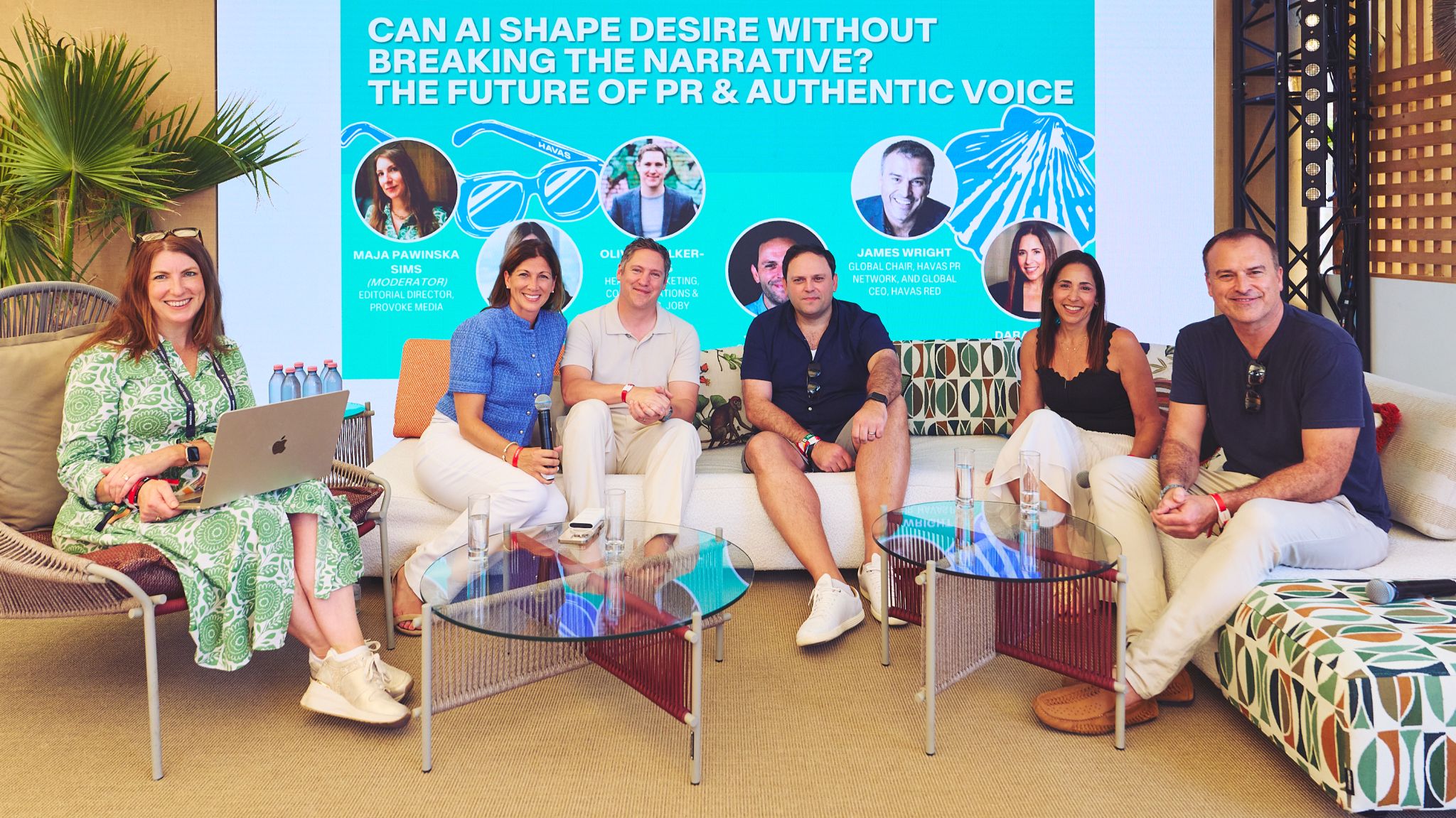
One of the most consequential shifts explored at Cannes: Large language models are dramatically increasing the value of earned media. This was a theme of the HAVAS Red × PRovoke Media panel, on which James Wright and Dara Busch, HAVAS PR North America CEO, spoke.
In this new AI-driven discovery environment, what matters is not just what brands publish but what credible third parties say, as highlighted by PRovoke in its panel wrap-up. This is turning trade and vertical media, once secondary, into primary inputs because they offer the depth and authority machines favor, Wright noted in a post-panel discussion with PRovoke Editorial Director Maja Pawinska Sims. “LLMs are pulling from the sources that most accurately answer the question,” he said — often prioritizing deep, specialist content.
Bottom line: You’re no longer optimizing for search — you’re shaping what machines say about your brand. If you’re not earning authoritative and accurate coverage, you can be invisible or misrepresented where it matters most.
Cannes reinforced a critical distinction — captured in Malcolm Gladwell’s Havas Café session on “The Currency of Trust”: Being right is no longer the same as being believed. Across conversations on credibility and AI, trust and expertise were repeatedly framed as separate, and often confused, signals.
In an AI-mediated ecosystem, that distinction has real implications. Credibility is no longer just a reputational outcome, but a visibility driver.
Reinforcing this dynamic is HAVAS’ “Science of Desire,” a landmark global study that HAVAS Chairman and CEO Yannick Bolloré revealed at Cannes exploring how brands build desire and how desire powers business growth. Brands that build stronger emotional connection and trust are significantly more likely to be surfaced in AI outputs — up to 4X more likely to be cited in some cases.
Bottom line: Expertise gets you indexed. Trust gets you surfaced and believed. Corporate comms must treat credibility as something designed and reinforced, not assumed.
Inside the PR Lions jury room, the message was clear: PR has earned its seat at the table. As Jury President and HAVAS Red Middle East CEO Dana Tahir put it in Little Black Book, “What I love about PR is that it has become one of the most powerful drivers of cultural relevance. The best ideas rarely begin with what a brand wants to say; they begin with understanding the conversations, shifts and behaviors shaping the world around us, then finding a space where the brand can genuinely add value.”
The strongest work at Cannes demonstrated PR’s ability to influence business outcomes, culture and real-world behavior.
At the same time, a parallel conversation emerged across Cannes: What is the role of the agency itself? With AI accelerating execution and creators reshaping influence, the traditional model is under pressure. As agency leaders argued, the issue is whether PR agencies deliver clarity, creativity and results, according to Little Black Book.
Bottom line: CMOs are demanding sharper thinking, clearer value and measurable impact from PR. And work that succeeds is defined by one strong idea, rooted in culture and proven in outcomes.
AI has moved from advantage to expectation. But as Dara Busch noted on LinkedIn, “If you put mediocre ideas into AI, you’ll get mediocre outputs.” During a Cannes conversation with PRovoke Media, Busch described the best approach to AI usage as a “bookended” process — starting and ending with human judgment. “You have to start with human ideas and vision,” she said, “then let AI take those ideas and that vision on a journey — but at the end, it has to be refined by humans. We can’t rely on AI for the finished product. Clients don’t want it. Media don’t want it.”
James Wright saw this borne out across the juries. AI also showed up in a far more considered way at this year’s show, he noted. “Whilst AI featured in some work, it was more of a supportive plank — driving better intelligence and insight to feed the core idea,” he said. “The last few years we’ve seen a lot of AI award slop, just using AI for AI’s sake in a campaign. I was delighted to learn via Dana (Tahir) that there was very little of this in the PR Lions this year and that this was markedly different to even 2025.” For Wright, that more thoughtful approach points to a sharper way of thinking about the technology: “It should be thought of as a way for us to unlock further potential in ourselves and our teams, giving us extra superpowers. Then taking what it gives us, adding human ingenuity and thinking, and ultimately finding that unfair advantage for the brands we work with.”
Bottom line: Across Cannes, the response was consistent: Creativity must remain human-led, AI-enabled. Technology can scale output, but it cannot replace judgment, narrative clarity or cultural understanding.
If AI is reshaping discovery, HAVAS’ new “Science of Desire” research is reframing selection, reported MediaBrief. The finding is stark: A widespread “desire deficit” persists, with 84% of brands sitting in a middle ground of indifference and achieving just 61% of their potential.
Brands must create stronger reasons to be chosen and keep being chosen over time. The findings reveal that desire operates through three interconnected drivers — attraction, affinity and attachment — forming a reinforcing loop that compounds over time. It also influences AI visibility, with emotionally resonant brands more likely to be surfaced and recommended.
Bottom line: According to the “Science of Desire” report, behavioral science suggests desire strengthens before conscious evaluation begins, through signals that make brands feel exciting, rewarding and worth orienting towards. Brands should therefore design experiences in signature moments that build momentum and anticipation over time — creating cues that travel socially and build value as people see, share and validate them, not simply through exposure alone.
Take the next step and reach out today.